Machine-translated from the official source document.
SHEEP POX
IS A VERY DANGEROUS CONTAGIOUS ANIMAL DISEASE
THAT HAS REAPPEARED IN OUR COUNTRY AND THREATENS SHEEP AND GOATS
How can we detect in time whether our animals have been infected with sheep pox?
We examine our animals every day (mainly sheep but also goats)
- on the head and face
- on the belly
- on the udders
- in the armpits
- on the genitals
- at the base and inside of the tail
- on the inner side of the thighs
- on any other hairless part of the body
We look carefully for:
Redness, red pimples, black crusts, sores, nasal discharge, tears
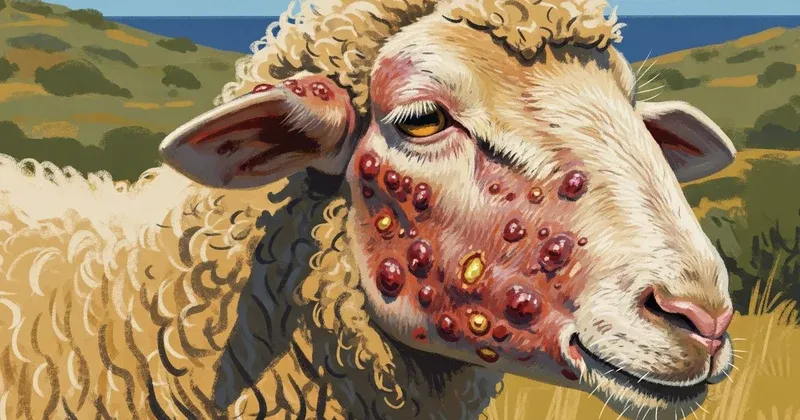
Sheep with extensive sheep pox lesions on the head, face and belly. Red pimples (papules).
Characteristic sheep pox lesions at the base of the tail. Red pimples (papules).
Typical sheep pox lesions. Red pimples (papules).
Advanced sheep pox lesions. Sores (ulcers).
Advanced sheep pox lesions. Black crusts (scabs).
Extensive sheep pox lesions across the entire belly, udders, thighs, genitals and base of the tail. Redness (spots) and red pimples (papules).
Advanced sheep pox lesions. Black crusts (scabs) and sores (ulcers) on the same animal.
Sheep with sheep pox lesions on the face. Redness (spots), red pimples (papules) and nasal discharge (nasal secretion).
Photographs of lesions: Konstantinos Dadousis, Anna-Maria Baka
If we observe any of the above in one or more animals, we immediately notify the Public Veterinarians of our area and faithfully follow their instructions.
IF YOU SUSPECT THAT YOUR ANIMALS MAY HAVE CONTRACTED SHEEP POX, DO NOT WAIT – NOTIFY THE PUBLIC VETERINARIANS IMMEDIATELY. THE HERDS OF YOUR ENTIRE AREA MAY BE AT RISK.
For additional information you can contact the local veterinary authorities of your area directly.
What must we do to prevent the transmission of sheep pox to our farm?
- We always consult the local veterinary authority of our area in advance if we intend to purchase animals, feed or other materials (e.g. bedding) that we will use on our farm.
- We avoid visiting other sheep and goat farms or allowing visitors to our own farm.
- We do not borrow tools and materials, or rams and billy goats from other farms.
- We inform the veterinary authorities if we detect illegal or suspicious movements of animals.
- We secure the entrance to our barn so that no one can enter when we are away.
- We operate a disinfectant footbath at the entrance to the barn.
DEAR FARMER
SHEEP POX – A DISEASE THAT ONCE AGAIN THREATENS THE SHEEP AND GOATS OF OUR COUNTRY
What is sheep pox?
Sheep pox (or simply pox) is a very contagious disease caused by a microbe (virus).
Which animal species are affected?
The disease affects sheep and goats. In our country, symptoms have so far been observed mainly in sheep; however, goats can also be infected.
How is sheep pox transmitted?
Healthy animals contract the disease when they come into direct contact with infected animals, but also after indirect contact with infected objects or products (e.g. tools, vehicles, hay, bedding, wool, hides, etc.).
How will I know if my animals have contracted sheep pox?
Initially, animals (mainly sheep) show malaise, loss of appetite and fever, and may also have nasal discharge and tears.
Skin lesions then appear that are most visible on the head, face and generally on the hairless parts of the body (armpits, belly, inside of the tail, udder, genitals).
These consist of redness (red spots) and pimples, usually red in colour, 0.5–1 cm in size (papules).
Gradually (after 5–10 days), the redness and pimples turn into round black crusts (scabs) and open sores (ulcers).
Due to the skin lesions, the animal's head usually appears swollen and disfigured.
At first, only 1–2 animals may be affected, but very soon the other animals in the herd are also infected, and quickly the other herds in the same area are also contaminated.
Are humans at risk from sheep pox?
No, the disease does not infect humans. However, if a person visits an infected farm or comes into contact with infected animals, they may inadvertently (mechanically) transmit the disease to healthy animals and infect them (e.g. through their hands, shoes, clothing, etc.).
What can we do to prevent sheep pox from entering our herd from infected areas of other countries?
If we are planning to travel abroad, we ask the local veterinary authorities whether the country we will visit has sheep pox or another contagious animal disease and follow their instructions. In any case, when abroad, we must avoid visiting farms or other places where animals are gathered (e.g. markets, etc.).
Why are sheep pox significant for the whole country?
When a country has sheep pox, neighbouring countries may ban imports of sheep and goats and their products from that country in order not to contract the disease themselves.
Why is it important to notify the public authorities immediately whenever sheep pox is suspected?
The sooner we detect sheep pox and take appropriate measures, the more we reduce the risk of the disease spreading to neighbouring herds and neighbouring areas. For this reason, reporting of the disease is also mandatory by law.
For additional information you can contact the local veterinary authorities of your area directly.
Photographs of lesions: Konstantinos Dadousis, Anna-Maria Baka
Prepared by: Ministry of Rural Development and Food, General Directorate of Veterinary Services, Directorate of Animal Health, Department of Infectious and Parasitic Diseases
HELLENIC REPUBLIC
REGION OF CRETE – Heraklion
GENERAL DIRECTORATE OF AGRICULTURAL ECONOMY AND DEVELOPMENT
VETERINARY DIRECTORATE
TO: Distribution List
Postal Address: Platonos 67, 71307 Heraklion
Contact persons: Lamprinidi Sofia, Giannetaki Timothei
Tel.: 2810221624, 2892022337
Email: [email protected], [email protected]
SUBJECT: "Preventive measures for Sheep Pox in small ruminants"
THE GENERAL DIRECTOR OF AGRICULTURAL ECONOMY AND DEVELOPMENT
Having regard to:
- Law No. 3852/2010 (Government Gazette 87/Vol. A/07-06-2010) "New Architecture of Local Government and Decentralised Administration – Kallikratis Programme", as replaced and in force under Article 5 of Law 4071/2012 (Government Gazette 85/Vol. A/11-04-2012) "Regulations for local development, local government and decentralised administration – Incorporation of Directive 2009/50/EC".
- Decision No. 10650/24-11-2025 (Government Gazette 6523 B) of the Secretary of the Decentralised Administration of Crete "Amendment to the Internal Service Regulation of the Region of Crete".
- The provisions of Presidential Decree 138/1995 "Establishment of general measures to combat certain animal diseases as well as specific measures for swine vesicular disease, in compliance with Council Directive 92/119/EEC" (A' 88).
- Decision No. 1747/386028/18-12-2023 of the Minister of Rural Development and Food "Emergency action plan for the control of diseases in Annex I of Presidential Decree 138/1995 A' 88" (Government Gazette 7121 Vol. B').
- Commission Delegated Regulation (EU) 2020/687 "supplementing Regulation (EU) 2016/429 of the European Parliament and of the Council with regard to rules for the prevention and control of certain listed diseases".
- The fact that sheep pox disease is caused by a virus which shows high transmissibility and can survive in the external environment for up to 6 months and can additionally be transmitted mechanically, among other routes.
- The fact that, although the island of Crete is free from sheep pox disease, the disease has not been controlled in the rest of Greece and there is additionally an increase in cases.
- The need to take preventive measures to prevent the entry and spread of sheep pox disease in Cretan farms.
- Following a relevant meeting of representatives of the veterinary services of Crete with the General Director of the Primary Sector and the Vice Regional Governor for Agricultural Economy of the Region of Crete.
- Decision No. 323410/23-09-2025 of the General Director of the Primary Sector "Preventive measures for Sheep Pox in small ruminants".
- Decisions No. 332765/01-10-2025, 343706/09-10-2025, 356086/17-10-2025, 366888/27-10-2025, 378000/05-11-2025, 388530/13-11-2025, 399051/20-11-2025, 408271/27-11-2025, 428452/11-12-2025 and 455134/31-12-2025 of the General Director of the Primary Sector "Preventive measures for Sheep Pox in small ruminants".
- Decisions No. 2154/07-01-2026, 20202/22-01-2026, 37190/05-02-2026, 51361/18-02-2026, 72939/05-03-2026, 91535/19-03-2026, 116069/03-04-2026, 128505/15-04-2026, 149564/30-04-2026, 166868/14-05-2026, 187208/28-05-2026, 204653/11-06-2026, 224390/25-06-2026, 244300/09-07-2026 and 262298/23-07-2026 of the General Director of Agricultural Economy and Development "Preventive measures for Sheep Pox in small ruminants".
- Circular No. 64918/13-03-2026 of MAAF "Application of measures on movements and slaughter of small ruminants in view of the Easter holiday period".
- Circular No. 110220/04-05-2026 of MAAF "Movement to summer pastures".
- Circular No. 146294/08-06-2026 of MAAF "Movement to summer pastures".
WE DECIDE
- Movements of small ruminants for immediate slaughter are permitted within the Region of Crete with strict observance of all necessary biosecurity measures.
- Movements of small ruminants for breeding are restricted within each respective Regional Unit, meaning they take place only within each Regional Unit with strict observance of all necessary biosecurity measures.
- Movements of small ruminants to summer pasture (change of pasture) continue to be permitted both within and outside each respective Regional Unit within Crete, in accordance with the prerequisites of points 14 and 15 above.
- The destination establishment must be cleaned and disinfected before the entry of small ruminants, which must remain at the destination establishment in quarantine for 30 days.
- All movements of small ruminants must be carried out with animal health movement certificates, using certified appropriate vehicles that have been disinfected before loading.
- The entry of small ruminants onto the island of Crete from farms in the rest of Greece remains prohibited.
- It is mandatory to provide a cleaning and disinfection certificate for the vehicle from the slaughterhouse, which shall be requested at the destination, upon the vehicle entering a farm for loading, and during checks by the competent authorities. The above measures are in force from Friday 07-08-2026 until Thursday 20-08-2026, when they will be reassessed.
By delegation
THE GENERAL DIRECTOR OF AGRICULTURAL ECONOMY AND DEVELOPMENT
LAMPRINIDI SOFIA
DISTRIBUTION LIST
RECIPIENTS FOR ACTION
- Association of Livestock Farmers of Heraklion Prefecture "Cooperation of Livestock Farmers of Heraklion Prefecture"
- Livestock Farmers' Association of Lasithi Plateau
- Livestock Farmers' Association of Lasithi
- Livestock Farmers' Association of Mylopotamos
- Association of Professional Livestock Farmers of Rethymno Prefecture
- Livestock Farmers' Association of Amari
- Livestock Farmers' Association of Anogia
- Livestock Farmers' Association of Chania
- Agricultural Livestock Cooperative of Chania Prefecture
- Police Directorate of Heraklion
- Police Directorate of Chania
- Police Directorate of Rethymno
- Police Directorate of Lasithi
- Port Authority of Heraklion
- Port Authority of Chania
- Port Authority of Siteia
- Port Authority of Rethymno
- Municipalities of Regional Unit Heraklion, Regional Unit Chania, Regional Unit Rethymno, Regional Unit Lasithi
- Slaughterhouse facilities of the Region of Crete
RECIPIENTS FOR INFORMATION
- Office of the Regional Governor Mr Arnaoutakis Stavros
- Office of the Vice Regional Governor of Regional Unit Heraklion, Mr Syrigonakis Nikolaos
- Office of the Vice Regional Governor for Agricultural Economy, Mr Tzedakis Stavros
- Office of the Vice Regional Governor of Regional Unit Rethymno, Ms Lionis Maria
- Office of the Vice Regional Governor of Regional Unit Chania, Mr Kalogeris Nikolaos
- Office of the Vice Regional Governor of Regional Unit Lasithi, Mr Androulakis Ioannis
- Veterinary Directorate of the Region of Crete
- Directorate of Agricultural Development and Veterinary of Regional Unit Chania
- Directorate of Agricultural Development and Veterinary of Regional Unit Rethymno
- Directorate of Agricultural Development and Veterinary of Regional Unit Lasithi
- Ministry of Rural Development and Food, General Directorate of Veterinary Services, Directorate of Animal Health, Department of Infectious and Parasitic Diseases, Acharnon 2 – 101 76 Athens