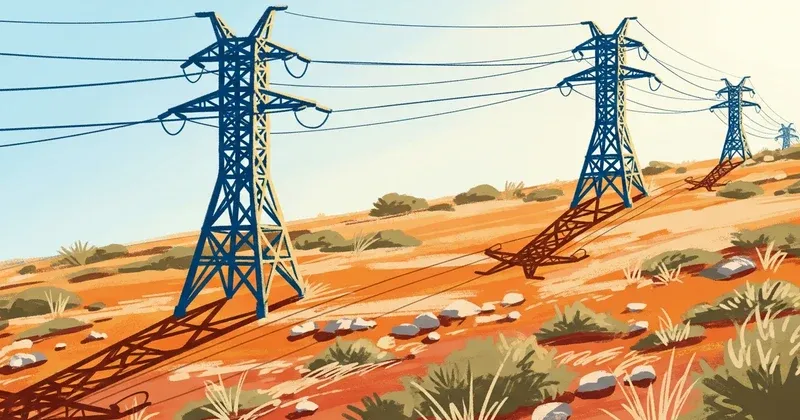
"It was never scaremongering — it was the truth"
Apokoronas takes its wildfire warning to Greece's highest court, backed by university research
For years, residents and officials in Apokoronas were told they were overreacting. Their repeated warnings — that ageing overhead power lines and high-voltage pylons posed a serious wildfire risk to Crete's forests and communities — were brushed aside. On August 4, 2026, Mayor Charalampos Koukianakis issued a pointed press statement: the evidence has arrived, and it proves they were right all along.
The mayor points to a growing body of research and real-world incidents linking electricity grid infrastructure to wildfire ignition. Most significantly, a scientific study produced by the National Technical University of Athens has been submitted as part of the municipality of Apokoronas's formal legal challenge before the Council of State — Greece's supreme administrative court. The study, the mayor says, provides documented, evidence-based support for the position the municipality has held from the start.
Blame the policy, not the workers
Koukianakis is careful to direct his anger at the right target. The employees of DEDDIE — the Greek electricity distribution network operator — are not at fault, he says. They do demanding, often selfless work on the ground every day. The responsibility lies instead with decades of political decisions: a grid allowed to grow old without adequate investment, an underground cabling programme that moved too slowly, understaffed services, and an institutional mindset that treated prevention as a cost rather than an investment.
"Instead of reflecting critically, instead of saying 'yes, we need to change course,' what do they do? They look for someone to blame among DEDDIE's workers," the mayor writes. He rejects that approach firmly.
New pylons planned despite everything
What particularly angers Koukianakis is that, even as this evidence comes to light, plans continue for new high-voltage pylons to be erected on Crete's mountain ranges. He argues this shows a refusal to learn from the tragedies that unfold every summer — and amounts to a continued assault on the natural environment.
The municipality's demands are clear:
- Underground cabling wherever it is needed, prioritising fire-risk zones
- Safe, modernised grid infrastructure to replace ageing overhead lines
- No new high-voltage pylons on Crete's mountain landscapes
- Political accountability for the decisions that created this situation
What comes next
The municipality of Apokoronas has already acted. Its legal challenge before the Council of State is on record, supported by the National Technical University study. Mayor Koukianakis has pledged to keep fighting: "We will continue to struggle, because we are defending our home, our children, and their right to live in a Crete that is safe, alive, and free."
For residents of Apokoronas and the wider Crete region, the case matters beyond local politics. If the Council of State rules in the municipality's favour, it could reshape how grid infrastructure is planned and built across the island for years to come.