News
Back to news
Apokoronas takes high-voltage power line dispute to Greece's top court
Press release · Municipality of Apokoronas

Apokoronas takes high-voltage power line dispute to Greece's top court

Summary

Apokoronas municipality has filed a case at the Greek Council of State against the planned high-voltage transmission line between Chania and Damasta, which would pass through the area. The municipal council argues that the current regulatory framework for renewable energy projects reduces local authorities to advisory bodies and effectively excludes residents from decisions affecting their land and livelihoods. The case targets what the municipality describes as a broader pattern of top-down infrastructure planning that bypasses local communities.

Apokoronas challenges power line plan in Greece's highest administrative court

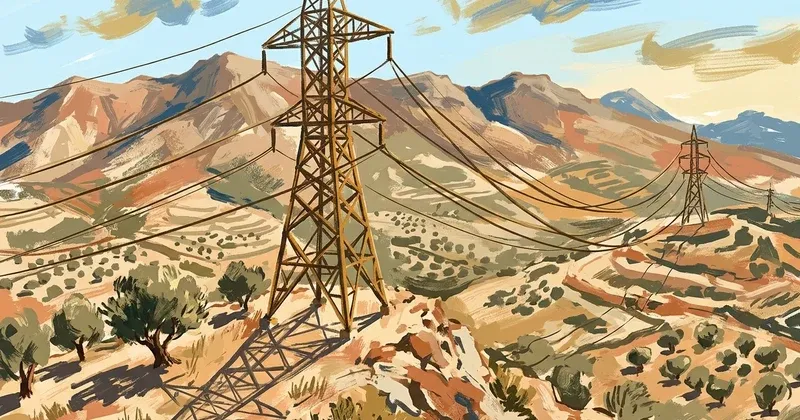
Apokoronas municipality has taken its opposition to a planned high-voltage electricity line to Greece's Council of State, the country's supreme administrative court. The legal challenge concerns the proposed Chania–Damasta transmission line, whose planned route would pass through the municipality's territory, crossing mountain terrain, grazing land and agricultural areas.

The dispute

The municipality's objection is not to the energy transition itself, according to its statement, but to the way this particular project — and the wider regulatory framework for renewable energy infrastructure — is being handled. The council argues that recent changes to that framework have stripped local authorities of any meaningful say, reducing them to consultative bodies whose opinions carry no binding weight. Ordinary residents, it says, are effectively excluded from the process entirely.

The planned line would affect upland areas, pastures and farmland in the Apokoronas area. The press release does not specify which villages or districts would be most directly affected by the route, nor does it give technical details about the line's length or capacity.

Legal action and what comes next

Filing a case at the Council of State is the most formal institutional step available to a Greek municipality. The council describes it as a deliberate choice — using the legal system rather than street protest to make the case that infrastructure decisions of this scale require genuine community consent.

No date has been given for when the court might rule on the application.

Criticism of institutional silence

The municipality's statement also singles out what it calls the silence of other elected and institutional representatives on the issue, characterising that silence as a political position in itself — one that, intentionally or not, leaves local communities exposed to decisions made without their input.

Note: This report is based on a press release issued by Apokoronas municipality. No statements from the energy authorities, the grid operator or the national government are included in the source.

Official source

Source translation

Machine-translated from the official source document.

Press release "Who decides about our region? – Apokoronas's answer is clear"

April 23, 2026, 2:34 PM

The question of the routing of the Chania–Damasta high-voltage line, as planned, is not a technical question — it is deeply political, democratic and existential for our region. In Apokoronas we are not reacting out of a rejection of progress. We are reacting to imposition. We are reacting to a development model that attempts to pass over local communities, as if they were mere spectators in their own homeland.

The emerging framework for renewable energy sources, with expedited procedures and a restriction of the role of local government, leaves no room for misinterpretation. When municipalities are turned into decorative consultants and citizens are effectively excluded from decision-making, then we are not talking about development. We are talking about the imposition of policy without social legitimacy.

Our appeal to the Council of State is an act of responsibility — an institutional response from a society that refuses to stay silent, that refuses to accept that its future can be decided without it. Because what is at stake here is not simply the location of certain projects. What is at stake is whether mountain massifs, pastures, agricultural production and our cultural continuity will remain living elements of our region, or whether they will be turned into fields of one-dimensional exploitation.

The silence observed among institutional representatives is not neutral — it is a stance. And that stance, whether out of fear or calculation, leaves local communities exposed to decisions that do not represent them.

Apokoronas, however, does not stay silent.

It sends, once again, a clear, non-negotiable message in every direction:

Projects without the consent of the local community are not accepted.

We will not allow our future to be planned without us. We will not accept that the balance of our region be sacrificed in the name of a development that takes no account of people, the environment and history.

This region has memory. It has struggles. It has people who learned to defend their land — not with ease, but at a cost.

And if some believe that communities grow tired or give ground, Apokoronas proves the opposite.

With unity, with documentation, with institutional means and with clear words, we will be present.

Because at the end of the day, the question is:

Who decides about our region?

And the answer, for us, is one: the people of this region decide.